
Are you looking for the best things to do in Bali? Whether you’re after temple sunsets in Uluwatu, rice terraces in Ubud, or just trying to figure out where to even base yourself, let me show you how to make the most of it.
I’ve been to Bali one too many times. First with my family in 2011, visiting Bali for the first time, then another time during uni, where I went cafe hopping all around Canggu and Seminyak in 2016. In 2017, I visited Labuan Bajo with the Indonesia Tourism Board.
In recent years, from 2022-2024, I spent 2 months in Bali each time, over multiple trips, for different intentions – either to celebrate the New Year with a bang and then start the new year in wellness classes to start the year with intention, or to be in digital nomad circles and be part of a community – honestly, that feels great.
Six months in, I still hadn’t run out of new corners of this island, and that’s genuinely the moment I knew Bali wasn’t going to be a normal trip report.
I came for what was meant to be a few weeks. I stayed long enough to track my actual cost of living properly, work out of oceanfront cafés in Canggu on days I should’ve been sightseeing, and slowly realise the island has an entirely different personality depending on which 20-minute drive you’re willing to make.
This guide covers Bali pretty much for:
- first-timers who want Ubud and a beach area done properly
- digital nomads eyeing Canggu
- surfers heading for Uluwatu’s cliffs
- slow-travel types who want to actually live somewhere for a stretch rather than tick off a temple list.
Think of this as your one-stop Bali travel planner. Let’s get into it.
READ ALSO:

10 Unforgettable Things To Do In Bali, Indonesia
Accurate Cost of Living in Bali, Indonesia!
BaliEasy eSIM Review
Bali At A Glance

Melasti day in Bali, Indonesia
Short on time? Here’s everything you need to know in one place.
| Currency | Indonesian Rupiah (IDR) |
| Language | Indonesian (Bahasa Indonesia), Balinese widely spoken locally |
| Plug type | Type C/F, 230V, 50Hz |
| Visa | Most Western passport holders get a 30-day Visa on Arrival (extendable once), or a Visa-Free entry depending on nationality; check current rules before you fly |
| Entry fee | A one-time IDR 150,000 / USD 9.30 tourism levy applies to every foreign visitor, pay online via the official Love Bali portal before you fly or at the airport |
| Time zone | Central Indonesia Time (UTC+8), no daylight saving |
| Best time to visit | April–June or September (dry season, thinner crowds) |
| Driving | On the left |
| Hello / Greetings | Om swastiastu (formal Balinese) / Hai (casual Indonesian) |
| Thank you | Terima kasih |
A few things about the island still surprise me even after months of living here, the kind of details that don’t show up in any guidebook until you’ve actually lived through them.
That’s how I learned facts about Bali no one told me about. They give me a more cultural picture of how I write this guide.
Best Time To Visit Bali, Indonesia
Bali runs 2 broad seasons, and where you’re headed on the island matters almost as much as when you go.
Dry Season (April–October)
This is peak season, and for good reason: consistently sunny days, calmer seas for boat trips out to Nusa Penida or the Gilis, and the best conditions for Uluwatu’s surf breaks.
July and August specifically get genuinely crowded and pricier.
April to June and September are the sweet spot, same weather, noticeably thinner crowds.
Rainy Season (November–March)

Hanging Gardens of Bali
Let me be honest with you: rainy season in Bali sounds a lot worse than it is. It rarely rains all day. Mornings are usually clear and sunny, then the clouds build after lunch, and you get an hour or 2 of heavy tropical downpour before it clears again.
The wettest months are December to February, when those afternoon storms are almost daily. November and March sit on the edges of the season, with more dry days, which makes them my favourite months to book.
The upside is that prices on villas and tours drop noticeably, outside the Christmas and New Year rush.
The rain also turns Ubud’s rice terraces their most vivid green. If the classic Tegalalang photo is part of why you’re coming, this is the season for it. Go early, before the afternoon clouds roll in.
Rainy season is also the best time for white-water rafting on the Ayung River. The higher water makes the rapids bigger and the currents faster than in the dry months, so the run is far more exciting. Tours are cancelled if the river becomes unsafe after very heavy rain, so book it early in your trip to leave a back-up day.
My advice is to plan around the rain rather than fight it. Do your sightseeing and beach time in the morning, and save your afternoons for temples, spa treatments or cafés.
A cold plunge and yoga at The Istana in Uluwatu, my favourite spot on the island, is a perfect way to wait out a storm.
Pack a proper raincoat rather than an umbrella, as the wind makes umbrellas useless on a scooter.
Unmissable Areas To Visit In Bali, Indonesia
Bali’s small enough to cross in a couple of hours by car, but each area has a completely different personality, and where you base yourself shapes the whole trip more than almost anywhere else I’ve been.
1. Ubud
Ubud is Bali’s cultural and spiritual heart – rice terraces, temples, and a slower pace that make it genuinely hard to leave once I settle in.
The Tegalalang terraces get the crowds, but early morning before the tour buses arrive is when they’re actually still.
If tea and quiet luxury sound like your kind of afternoon, high tea at the Hanging Gardens overlooking the jungle canopy is genuinely one of the more indulgent things I did here, a proper splurge, and I don’t regret a single rupiah of it.
2. Canggu
Canggu is where I ended up spending the most time by far, working remotely, chasing surf breaks, and slowly discovering there’s a genuinely good café on every second corner.
It’s Bali’s digital nomad capital for a reason: fast Wi-Fi, a strong community, and beach sunsets that make the workday genuinely bearable.

Sunset at the beach, Bali, Indonesia
I worked out of more cafés here than I can count, and I’ve narrowed down where the sunset coworking sessions actually deliver: oceanfront, good coffee, and Wi-Fi that doesn’t drop mid-call.
3. Uluwatu
Uluwatu sits on Bali’s southern cliffs, and it’s the pick if surf and dramatic scenery matter more to you than nightlife.
Uluwatu Temple itself, perched right on the cliff edge with wild monkeys wandering the grounds, looks best at sunset, and the surf breaks below draw a serious crowd of surfers year-round.
After a few too many days chasing waves, a proper treatment at The Spa at The Edge, clifftop views included, was exactly the reset I needed.
4. Seminyak
Seminyak is Bali’s more polished beach town – upscale restaurants, boutique shopping, and a beach club scene that’s become genuinely famous in its own right.
The beach club scene deserves proper attention too; I’ve tried genuinely more of them than is sensible, and rounded up 17 best beach clubs that actually earn the hype across the island that’s not just in Seminyak.
5. Nusa Penida
Nusa Penida is the wild, dramatic island most Bali itineraries eventually pull you towards.
Fast boats leave Sanur every morning and take 30–45 minutes, so a day trip is doable. If you can, though, stay at least 1 night. The island is bigger and slower to get around than it looks, and the best attractions are spread out across both coasts, so you’ll see far more without racing the last boat back.

Kelingking Beach, Nusa Penida, Indonesia
Kelingking Beach is the one everyone comes for, with its T-Rex-shaped cliff plunging into turquoise water. The viewpoint at the top is easy to reach, but the climb down to the beach is a serious workout.
The old rope-and-dirt path has been replaced with proper steps, but they’re still steep, dusty and loose underfoot. Allow about 30–40 minutes down and longer to get back up.
Go early in the morning, before the tour vans arrive and the midday sun makes the climb brutal, and wear proper shoes rather than flip-flops.
Broken Beach and Angel’s Billabong sit about 30–40 minutes further along the west coast, and they’re close enough to visit in one stop.
Broken Beach is a circular bay where the sea flows in through a huge natural rock arch.
Angel’s Billabong is a rock pool fed by the ocean. It looks calm in photos, but waves can crash over the edge without warning, so only get in at low tide on a calm day, and stay out completely if the sea is rough.
If you actually want to swim, head to Crystal Bay. It’s calmer and easier to reach than the cliff beaches, with palm trees, clear water for snorkelling and boats bobbing offshore. It faces west, so stay for sunset before heading back to your hotel.
If you stay an extra night, cross to the east coast for a completely different side of the island. Diamond Beach has a staircase carved straight into the cliff, leading down to white sand and bright blue water, with Atuh Beach right next door.
Inland, the Goa Giri Putri cave temple is entered through a tiny gap in the rock that opens into a huge cavern used for ceremonies. These attractions see far fewer day-trippers, so they feel much quieter.
One warning: Nusa Penida’s roads are rough, narrow and full of potholes, with steep, sandy sections near the big viewpoints. Unless you’re very confident on a scooter, hire a car with a driver for the day. It’s safer, and your driver will know the order to do the sights in to beat the crowds.
6. The Gili Islands
The Gilis are a completely different kind of island. There are no cars and no scooters, just bicycles and cidomos (small horse-drawn carts), so the only sounds are the waves, the bike bells and the call to prayer drifting over from Lombok. It’s hard to describe how slow life feels there until you’re standing on a beach with no traffic at all.
Each of the 3 islands has its own personality, so it’s worth choosing carefully:
- Gili Trawangan is the biggest and liveliest. It’s where most younger travellers head for beach bars, late nights and the island’s many dive shops, and you can snorkel with sea turtles just off the beach.
- Gili Meno is the smallest and quietest. It’s the romantic pick, with long empty beaches and the underwater statues just offshore, and very little to do besides read, swim and watch the sunset.
- Gili Air sits right in the middle, in every sense. It’s laid-back, with good beaches and plenty of cafés and restaurants, but without Trawangan’s party noise.
Getting there confused me the first time, so I mapped out exactly how to get from Bali to the Gili Islands, including which ports to use and how long each boat takes.
If you’re visiting Nusa Penida too, there’s a shortcut most people miss. Fast boats run directly from Nusa Penida to the Gilis, so you can do Penida first and carry straight on, without going back through Bali.
17 Must-Do Things In Bali, Indonesia
Bali blends ancient temples, genuinely world-class cafés, and volcanic landscapes in a way that’s hard to find anywhere else this size.
Here are the things to do in Bali that genuinely deserve your time, organised by where you’ll find them.
Ubud: Temples, Terraces & Culture
1. Visit Tirta Empul Temple
A holy spring temple over 1,000 years old, where you can join Balinese pilgrims for a purification bathing ritual. I went early in the morning specifically to avoid the crowds, and it made the whole experience feel considerably more genuine.
Book your Tirta Empul purification tour here
2. Hike Mount Batur For Sunrise
An early 3 am pickup and a headlamp-lit climb, but watching the sun break over the volcano from the summit is genuinely one of the best things I’ve done in Bali.
If you want to go deeper into Indonesia’s volcanic landscapes beyond just Batur, I’ve put together a full guide to the country’s volcanic adventures.
Book your guided Mount Batur jeep sunrise tour here
3. Try A Sound Healing Class At Pyramids Of Chi
The design alone is worth the drive out: genuine pyramid-shaped structures built using sacred geometry principles, tucked into the jungle outside Ubud.
I went in expecting a slightly gimmicky wellness session and left properly zenned out; the acoustics inside the pyramids do something to the sound bowls that I genuinely can’t explain, just that I walked out calmer than I’ve felt after most spa days.
Book your sound healing class at Pyramids Of Chi here
4. Have Dinner At Merlin’s
This is unlike any dinner concept I’ve come across anywhere, part magic show, part upscale dining, and genuinely not something you can fully picture until you’re sitting at the table watching it happen.
Reservations book out well ahead, so I’d lock this in as soon as you know your Ubud dates rather than trying to walk in.
5. Go White-Water Rafting
The Ayung River, just outside Ubud, is where most of Bali’s rafting runs, and it’s a genuinely good adrenaline break between temples and rice terraces.
Grade II-III rapids, dense jungle walls on either side, and the occasional waterfall passing overhead, a proper couple of hours on the water rather than a token 20-minute float.
Book your Ayung River white-water rafting trip here
Canggu: Cafés, Surf & Digital Nomad Life
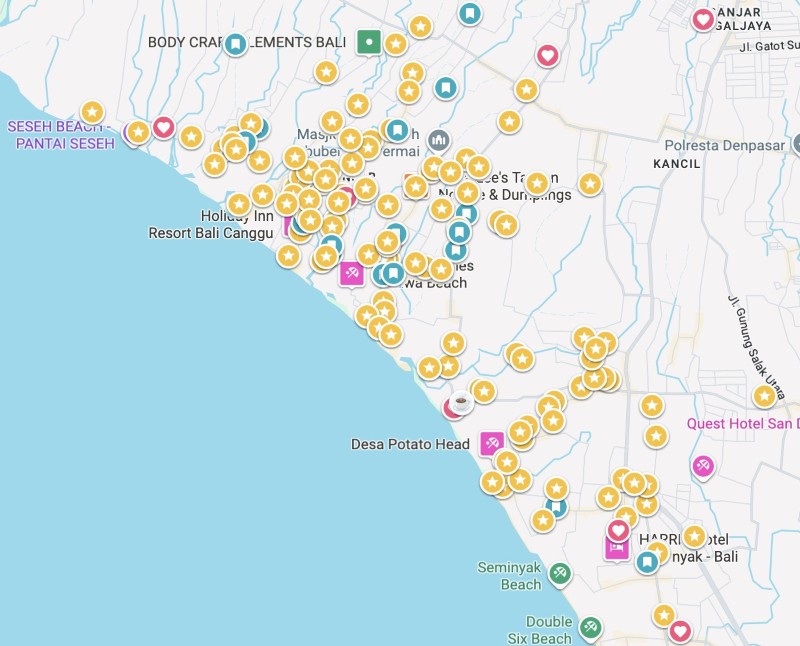
I have SO many recommendations of Canggu and the surrounds!
6. Work From A Sunset Coworking Café

Cafe at sunset in Bali, Indonesia
As a digital nomad, I can tell you Canggu’s café scene isn’t just a nice backdrop for your laptop. It’s one of the main reasons people come here to work. The coffee is far better than it has any right to be, the Wi-Fi is generally strong, and nobody blinks if you camp out at a table for 4 hours with a flat white and a smoothie bowl.
On a work day, I start at Tribal Bali, a coworking hostel in Canggu with proper desks, fast Wi-Fi, a pool and a community of other remote workers. It’s where I go when I have calls to take and deadlines to hit, and it’s an easy place to meet people if you’re travelling solo.
The real magic happens around 5 pm. Pack up your laptop and move to one of the beachfront cafés along Batu Bolong or Echo Beach, order an iced coffee or a cold Bintang, and finish your last emails while the surfers paddle out and the sky turns orange.
There’s something about sending that final message of the day with the sun setting over the Indian Ocean that makes the remote work life feel worth it.
Pro tip: grab a seat by 5 pm, as beachfront tables fill up fast before sunset. Bring a power bank, since plug sockets at beach cafés are usually limited.
7. Take A Surf Lesson

Surfing with an instructor in Bali, Indonesia
This is THE primary reason why I’d base myself in Canggu.
Canggu’s beach breaks are genuinely beginner-friendly, and I’d recommend a lesson even if you’ve surfed elsewhere before; the currents here have their own personality.
The downside to this is that it’s become so popularised that the ocean can get overcrowded with people learning to surf. Come early in the morning to avoid the crowds!
Book your Canggu surf lesson here
8. Watch Sunset At Tanah Lot
One of Bali’s most photographed temples, perched dramatically on a rock formation just offshore, cut off from the mainland entirely at high tide.
It’s genuinely worth braving the crowds for, and there are crowds; tour buses arrive in waves by late afternoon, but the silhouette of the temple against the water as the sun drops is exactly the reason everyone puts up with it.
Get there early enough to grab a spot along the cliffside path before the viewing area fills in, and skip the string of souvenir stalls leading up to it unless you genuinely want a magnet.
Book your Tanah Lot sunset tour here
9. Eat At A Proper Local Warung
Skip the café markup at least a couple of nights and eat where it’s actually cheap and genuinely good. A plate that costs a fraction of what you’d pay 2 streets over at a trendy Canggu brunch spot, and often tastes better for it.
- Warung Sika does simple, home-style Indonesian dishes that taste like someone’s actual family recipe.
- Tiga Canggu leans a little more polished without losing the warung pricing.
- Warung Local is the no-frills, plastic-chairs-and-fan kind of spot I’d trust with my life.
- Bakso Rudi does a proper Indonesian meatball soup that’s one of my favourite go-to spots if I want something hearty!
10. Shop The Local Markets And Streets
Bali Niki Art Market and Treasure Baliniki Market are where I’d actually go for souvenirs with some substance – handmade textiles, wood carvings, local art, rather than the mass-produced “Bali” magnets sold everywhere near the beach.
Love Anchor and Lestari Thrift Shop & Cafe Bali cover the other side of shopping here entirely – curated, a little more boutique, and both genuinely worth combining with a coffee stop since they’re café-adjacent spots you can happily lose an hour in without meaning to.
11. Browse The Sunday Market At La Brisa Beach Club
This is my weekly Sunday ritual.
A weekly market set right on the beach club grounds, with stalls selling everything from local produce to handmade jewellery, live music drifting over from the main bar area, and a genuinely relaxed way to ease into a Sunday before the rest of the day opens up.
It’s less touristy than it sounds; plenty of expats and locals treat it as a normal weekend routine rather than a tourist stop.
12. Watch Sunset At A Proper Beach Club

Finns Beach Club, Bali, Indonesia
If there’s one thing Bali does better than almost anywhere else, it’s sunset. Order a cocktail, find a lounger facing the ocean, and watch the sky go from gold to pink to purple while the DJ slowly turns the music up. It’s one of my favourite ways to end a day on the island.
Each beach club has a very different vibe, so it’s worth picking one that matches your mood:
- La Brisa at Echo Beach is my pick for something laid-back. It’s built from recycled wood and old fishing boats, so it feels like a beach shack that grew into a jungle hideaway.
- The Lawn in Canggu is exactly what it sounds like: low loungers on a grassy lawn facing the surf at Batu Bolong. It’s easy, unpretentious and perfect if you just want a drink and a view without the dress-up.
- FINNS Beach Club in Berawa goes big and loud. With multiple pools, a swim-up bar and a proper party atmosphere once the sun goes down, it’s the one to choose if you want to dance.
- Atlas Beach Club, also in Berawa, is the most photographed of the bunch right now. It’s enormous, with striking architecture, a giant pool and plenty of spots to get the shot.
- Café del Mar brings the famous Ibiza beach club brand to Bali. It’s more polished and upscale than the others, with a beautiful pool and consistently good DJs.
Pro tip: arrive by 4 pm to get a good spot for sunset, especially on weekends. Daybeds and front-row loungers usually come with a minimum spend, so check the price before you sit down.
Did you know you can book a Bali beach club and bar-hopping tour here?
Uluwatu: Cliffs, Surf & Sunset Temples
13. Watch Sunset At Uluwatu Temple

Sunset over Uluwatu cliffs, Bali, Indonesia
Uluwatu Temple sits on the edge of a cliff around 70 m above the Indian Ocean, and watching the sun go down from here is one of the most beautiful sunsets on the island.
The temple itself is closed to visitors, but you can walk the clifftop path on either side of it for sweeping views of the coastline and the waves crashing below.
The temple grounds are home to a large troop of long-tailed macaques, and they are not shy. They’re known for snatching sunglasses, hats, phones and even flip-flops, then holding them hostage until someone offers fruit. Put everything loose in a zipped bag before you walk in, and don’t carry food.
The highlight is the Kecak fire dance, performed every evening in an open-air amphitheatre overlooking the ocean as the sun sets. A circle of dozens of men chanting “cak-cak-cak” tells a story from the Ramayana, ending with a dramatic fire scene as darkness falls. It’s touristy, but seeing it with the sky turning orange behind the performers is unforgettable.
Pro tip: the Kecak dance starts at around 6 pm, but the best seats fill up fast, so buy your ticket and be seated by 5 pm. A sarong is required to enter the temple grounds, and you can borrow one at the entrance.
Book your Uluwatu Temple and Kecak dance tour here
14. Surf Uluwatu’s Cliff Breaks
Some of Bali’s most famous waves are in Uluwatu and are genuinely suited to intermediate and advanced surfers rather than a first lesson. Padang Padang and Bingin Beach both sit nearby if you want a break from paddling out.
Book your Uluwatu surf tour here
15. Recover With A Proper Spa Day
After a few days of surf and sun, The Spa at The Edge, with clifftop views over the ocean while you’re being worked on, was exactly what my body needed.
16. Cold Plunge Or Yoga At The Istana

Cold plunge group!
My personal favourite thing to do whenever I’m in Uluwatu is a contrast therapy session at The Istana. I slot this into every single Uluwatu itinerary without fail.
The views alone make it worth the trip, but the cold plunge is what keeps me coming back. Book ahead though, sessions run on specific time slots and fill up fast, so check their schedule before you plan your day around it rather than just showing up.
Book your cold plunge or yoga session at The Istana here
17. Party The Night Away At Savaya

Savaya Club in Bali
The most famous club in all of Bali, and it earns that reputation: international DJs on rotation, the kind of production and sound system you don’t expect on a clifftop in Uluwatu.
Check their program before you go; the lineup genuinely shifts week to week, and it gets especially wild in the lead-up to New Year’s. Book tickets early if that’s when you’re planning to be here.
Best Things To Do As A Digital Nomad In Bali, Indonesia

Meeting my digital nomad friends!
The digital nomad scene here has genuinely transformed since I first started coming. Bali’s been the world’s go-to remote work destination since around 2015, but the version I found post-pandemic is a different beast entirely – way more infrastructure, way more people, and a visa situation that’s finally catching up to the reality of who’s actually living here.
Indonesia is pretty strict on digital nomads working on a tourist visa, so much so that it now runs an E33G Remote Worker Visa, specifically for people earning income from outside the country. It’s a genuine step up from the old visa-run shuffle most of us used to do.
Canggu’s gentrified hard in that time too; prices have climbed noticeably from the pandemic-era lows. The trade-off is a coworking and community infrastructure that’s honestly hard to find anywhere else in Southeast Asia at this density.
Here’s where I actually spend my working hours when I’m here.
Best Coworking Spots In Bali, Indonesia

Days of working from a cafe
B Work
My favourite coworking space by a clear margin, but book ahead; seats are genuinely limited, and it fills up fast. Don’t just walk in expecting a desk to be free.
What makes it worth the planning is the community around it more than the desks themselves; they run regular meetups and skill-sharing sessions. I’ve walked away from casual chats with other members having learned something I’d never have picked up working alone.
There are standing desks and portable monitors available for you for free, on a first-come, first-served basis. That’s a luxury when you’re working remotely!
Fully air-conditioned too, which matters more than you’d think once midday humidity sets in and you’ve got a call to be sharp for.
Outpost Canggu Coworking
One of the original names in Bali coworking, and it’s held up well as the scene around it has changed. This is the go-to if you want to combine accommodation with coworking.
A solid, reliable option if B Work’s fully booked, the kind of place that’s been doing this long enough to have the logistics genuinely dialled in – fast Wi-Fi, proper desks, none of the teething issues newer spaces sometimes have.
Nebula
A newer entrant into the Canggu coworking scene, and it’s earned its place with genuinely fast, stable internet, the kind that doesn’t dip the moment 3 other people are on a video call at the next desk.
They brand themselves as the place for entrepreneurs to work from, and if you’re staying in Bali longer, you can opt to rent your own private office.
Tropical Nomad Coworking
Similar story to Nebula: dependable connectivity and a proper working environment, worth having on your shortlist if the more established names are booked out.
I personally don’t like the rooms that you work out from, as they feel small and cramped. There are both outdoor and indoor seating so there’s that choice you have.
Tribal Bali Coworking Hostel
Run by my travel blog friend Will, Tribal is worth knowing about specifically if you want work and accommodation under one roof. It’s a great go-to if you landed in Bali and haven’t sorted a villa yet, or if you’d rather not be commuting to a separate coworking space every morning.
ZIN Cafe
ZIN Cafe is a café-coworking hybrid on Jalan Nelayan in Canggu, a 2-minute walk from the beach. It’s one of my go-to spots when I want the energy of a coworking space without paying for a membership. I’ve put in a full day of real work there more than once.
The café is a 3-storey open-air building made of wood and bamboo, with plenty of plants and a breezy, very Bali feel. Next to it is ZIN@Work, a separate bamboo coworking area with proper work tables and an air-conditioned “focus room” for calls or deep work. There’s no desk booking and no pass. You spend a minimum of IDR 200,000 on food and drinks, and the space is yours for the day.
That minimum spend is easy to hit over a full day. ZIN roasts its own beans in-house, so the coffee is excellent, and the menu mixes healthy Western dishes with Indonesian favourites for when lunch comes around. It’s open from 6:30 am to midnight every day, so early birds and night owls are both covered.
Pro tip: if you have calls, grab a seat in the air-conditioned focus room early in the day. The open-air areas can get noisy, and the afternoon heat creeps in.
Best Gyms In Bali, Indonesia
My favourite part about gyms in Bali is something I haven’t really seen done this well anywhere else; most come with a proper recovery corner built directly into the facility, with cold plunge and sauna included, so a post-workout cooldown is just part of the routine rather than something you have to drive somewhere else for afterwards.
Nirvana
A regular for me, and it does the whole package properly – solid classes and equipment, paired with the cold plunge and sauna setup that makes the whole session feel considerably more complete than a standard gym visit.
This is where I met my all-time favourite yoga teacher, Kemi, who’s really excellent and very knowledgeable about what she does – that goes beyond the body.
Wanderlust
Wanderlust is my pick for one thing in particular: its surf-focused classes. Instead of a generic full-body workout, these sessions build the exact strength and mobility surfing demands.
That means rotator cuff work for paddling, core work for balance, and pop-up drills done over and over until the movement becomes automatic.
If you’re in Bali to learn to surf or to get better at it, this is the smartest way to train on dry land.
The surf training runs alongside a huge timetable of 50+ weekly classes, from CrossFit, the gym’s original speciality, to HYROX conditioning and mobility sessions. The compound itself covers 4,000 m², with a 25 m lap pool, saunas and ice baths in the recovery area. That makes it easy to turn one class into a full morning.
It sits on Jalan Raya Padonan, on the quieter edge of Canggu, about 10–15 minutes by scooter from the busy Batu Bolong and Berawa areas. If you’re staying in the centre, factor in the ride.
Pro tip: book a surf-specific class before your first lesson or surf trip. Learning the pop-up on land first makes your time in the water far more productive.
BYND
Genuinely challenging classes, the kind that push you rather than let you coast through on autopilot. Good if what you actually want is to leave feeling like you worked, not just went through the motions.
Body Factory
Sits right in town, which is genuinely convenient, but I’ll be honest, it’s overpriced and over-hyped by the Bali influencer crowd relative to what you actually get once you’re inside.
I’d point you toward Nirvana, Wanderlust, or BYND first and treat this one as a last resort.
My Favourite Yoga Spots In Bali, Indonesia
Samadi Bali
Samadi rounds out my regular rotation, and it’s the one I’d pick if you want structured classes with experienced teachers.
The studio on Jalan Padang Linjong, near Echo Beach, has a strong Ashtanga foundation, alongside daily Vinyasa Flow, Hatha and deeply meditative Yin. If you’d like to go beyond the mat, there’s breathwork, sound healing, tai chi and qi gong on the schedule too.
The open-air shala and leafy grounds make practising here feel like part of the Bali experience. It doesn’t feel like a class you could take in any city studio.
Samadi also runs yoga teacher trainings, which shows in the quality of the instruction. Teachers take time to adjust your posture and explain the why behind each pose.
If you’re in Canggu on a Sunday, take a morning class and then browse the Samadi Sunday Market, an organic market with local produce, homemade treats and handmade crafts, open from 9 am to 2 pm.
Nirvana Life
Nirvana is best known as one of Canggu’s top gyms, but its yoga classes are what keep me coming back between workouts.
The sessions lean towards callisthenics practice, so it’s a great fit if you want yoga that complements your training rather than replaces it.
I use it for the stretch and mobility work my body needs after surfing and lifting, when my shoulders, hips and hamstrings are tight.
The big perk is convenience. If you’re already a member at the gym, yoga is part of the same routine, with no second membership or another studio to get to.
You can also book Nirvana classes through ClassPass, which is handy if you only want to drop in a few times during your stay.
Serenity Eco Guesthouse & Yoga
Serenity is where I’d send you for a calmer, more traditional practice. The shala sits inside a family-run eco guesthouse on Jalan Nelayan, 150 m from the beach, surrounded by a permaculture garden. The noise of Canggu fades the moment you walk through the gate.
It also has the biggest yoga timetable in Canggu, with up to 10 classes a day across more than 20 styles.
You’ll find gentle hatha and yin for slow mornings, plus stronger options like power yoga and Jivamukti, a dynamic style mixing flowing sequences with chanting and meditation. Aerial yoga is offered too if you want to try something new.
Many classes are labelled beginner or all levels, so it’s one of the least intimidating places to start if you’re new to yoga.
You don’t need to stay there to join a class, as drop-ins are welcome. My tip is to take an early morning class, then stay for a vegan breakfast in the garden.
My 10-Day Itinerary in Bali, Indonesia
If you’re visiting Bali for the first time and want a sense of how the pieces fit together, here’s roughly how I’d structure 10 days in Bali – enough time to properly cover the cultural, adventure, and beach sides of the island without feeling rushed.
| Day | Location | Highlights |
|---|---|---|
| 1–3 | Ubud | Rice terraces, temples, a spa day, high tea at Hanging Gardens |
| 4–6 | Canggu | Café-hopping, surf lessons, sunset (coworking) sessions |
| 7–8 | Uluwatu | Cliff temples, surf breaks, a proper spa reset |
| 9 | Nusa Penida day trip | Kelingking Beach, Broken Beach, snorkelling |
| 10 | Seminyak | Beach clubs, a final night out before departure |
This is the shape I’d default to for a first-timer in Bali, but it flexes easily depending on what you’re actually chasing.
If you’ve got longer than 10 days, the Gili Islands or a deeper dive into Bali’s volcanic side are both good additions rather than something to rush. More on that below.
Where To Stay In Bali, Indonesia
Where you stay in Bali changes the whole feel of your trip, and prices swing considerably depending on the area and season. Here’s the full breakdown.
Ubud

Pandawas Villas room, Bali, Indonesia
Budget: Bali Moon Guesthouse is the one I’d point you to – a family-run, Balinese-style stay set right against the rice fields, with mountain views, large terraces, and free breakfast every morning, without the price tag of a proper resort.
Price: IDR 200,000–400,000 / USD 14–28 per night.
Mid-Range: Kaamala Resort sits right in the heart of Ubud, walkable to the Monkey Forest and the cafés along Goutama Street, but still wrapped in rice paddies and jungle once you’re back inside the gate. They offer Elegant rooms up to private pool villas, and 2 genuinely good restaurants on site if you don’t feel like heading into town.
Price: IDR 600,000–1,200,000 / USD 40–80 per night.
Luxury: I stayed at Pandawas Villas, a proper private-pool villa experience tucked into the jungle, and it remains one of my favourite stays anywhere on the island.
Price: IDR 1,800,000+ / USD 120+ per night.
Canggu
Budget: The Farm Hostel or my friend Will’s property, who runs TRIBAL Bali are well-known names here – social, pool included, and genuinely good for meeting other travellers.
Price: IDR 120,000–250,000 / USD 8–17 per night.
Mid-Range: Ayona Villa Canggu is a good example of the trade I mean here: one-bedroom pool villas with a private pool, daily afternoon tea, and a free shuttle to nearby attractions, about 30 minutes from the airport and close to Batu Belig Beach. It often costs the same as a mid-tier hotel room elsewhere on the island, but you get a full kitchen and considerably more space, a genuinely smart trade for stays of a week or more.
Price: IDR 600,000–1,200,000 / USD 40–80 per night.
Luxury: Beachfront villa compounds with private pools and full staff, genuinely indulgent if you’re here with friends or celebrating a special occasion.
If you want the opposite, somewhere quiet and tucked away rather than in the middle of Canggu’s buzz, I stayed at Spaces Bali, run by a fellow Singaporean, and it’s exactly the kind of private, slow-down-properly retreat I’d point you to when the rest of the island starts feeling like too much.
Price: IDR 2,000,000+ / USD 130+ per night.
Seminyak

-

- Hu’u Villas, Seminyak, Bali, Indonesia
Budget: Seminyak Point Guest House is a good example here, set back on Jalan Raya Seminyak, a short walk from the beach road rather than right on it, with comfortable rooms at genuinely reasonable rates without the beachfront markup.
Price: IDR 400,000–800,000 / USD 27–53 per night.
Mid-Range/Luxury: I stayed at Hu’u Villas, and it’s exactly the kind of property that explains Seminyak’s reputation: polished, central, and close to the best of the beach club scene.
Price: IDR 1,200,000–3,500,000+ / USD 80–235+ per night.
Uluwatu
Budget: Bingin Bienvenue Guest House sits a 5-minute stroll from Bingin Beach. Simple, charming bungalows, and close enough to everything worth walking to that a scooter isn’t strictly necessary.
Price: IDR 350,000–750,000 / USD 23–50 per night.
Mid-Range: Surf Bali Villa puts you right on the clifftop between Padang Padang and Bingin, with unbeatable sunset views from the room, and genuinely within walking distance to the best cafés and surf breaks in the area.
Price: IDR 1,200,000–2,700,000 / USD 80–180 per night.
Luxury: Bulgari Resort Bali is the name everyone mentions first, with traditional Balinese-styled villas on the clifftop and a private inclined elevator straight down to the beach.
Alila Villas Uluwatu sits right alongside it if you want to compare; all 3 have the same clifftop-infinity-pool fantasy Uluwatu’s known for.
Price: IDR 10,500,000+ / USD 700+ per night.
Getting Around Bali, Indonesia
Grab & Gojek
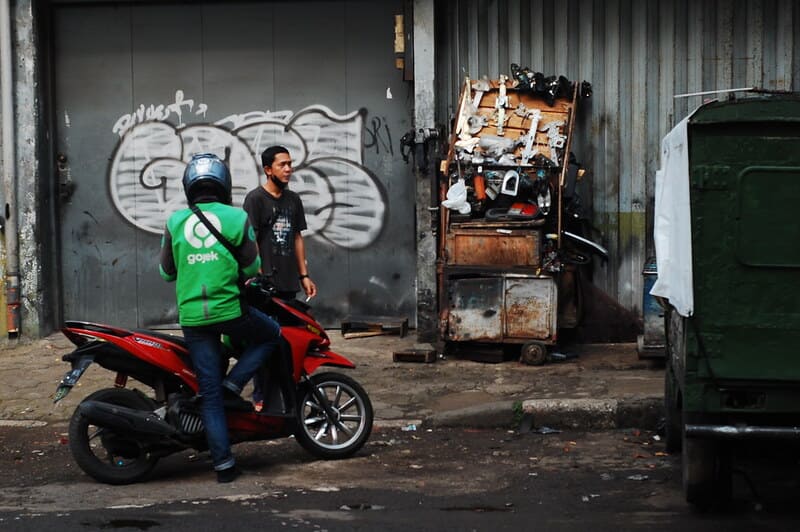
Gojek scooter!
Southeast Asia’s answer to Uber, Grab and Gojek are the easiest ways to get around for shorter trips within Canggu, Seminyak, or Ubud without negotiating a fare upfront. There are options for either a scooter or a car.
A short ride across Canggu runs IDR 20,000–40,000 / USD 1.25–2.50, and a longer cross-town trip, Ubud to Seminyak, for example, comes to roughly IDR 150,000–250,000 / USD 9–16.
Scooter Rental
The most popular option among independent travellers, roughly 70% of visitors rent a scooter at some point during their stay.
The price is low, at around IDR 60,000–90,000 / USD 4–6 per day, and genuinely the fastest way through Canggu or Ubud’s narrow lanes.
Even though I personally don’t have one, nor do they check for one, you’ll want a proper motorcycle licence and real riding experience, since insurance generally won’t cover you without one, and Bali’s traffic takes real getting used to.
It took staying in Bali for an extended time and multiple trips around the block before I got used to riding a scooter. Start small, with a Scoopy, before getting more comfortable with bigger scooters.
Private Driver
The option I’d actually recommend if you’re not a confident rider, particularly for day trips around Bali, out to Nusa Penida’s ferry port or the winding roads up toward Mt. Batur.
A full day with a private driver, covering the whole car rather than per person, runs around IDR 600,000–850,000 / USD 37–53, genuinely good value split between a group.
Typical Costs In Bali, Indonesia
Bali remains genuinely good value for the quality of experience on offer, though it’s no longer the ultra-cheap backpacker destination it was a decade ago.
I tracked my own spending properly during my time in Bali with my actual cost of living in Bali, if you want the real day-to-day numbers from someone who lived there rather than just visited.
Here’s what you can expect based on the type of travel style you’re doing:
| Travel Style | Per Person / Day | What It Covers |
|---|---|---|
| Backpacker | USD 25–45 | Hostel dorms, warung meals, scooter rental, free attractions |
| Mid-Range | USD 75–160 | Private villa or boutique hotel, café meals, a driver day here and there |
| Luxury | USD 320+ | Private-pool villas, fine dining, spa days, private transport |
Here’s the range for planning a trip in Bali:
| Trip Length | Backpacker | Mid-Range | Luxury |
|---|---|---|---|
| 1 week | USD 175–315 | USD 525–1,120 | USD 2,240+ |
| 10 days | USD 250–450 | USD 750–1,600 | USD 3,200+ |
| 1 month | USD 750–1,350 | USD 2,250–4,800 | USD 9,600+ |
A few price ranges worth knowing before you land:
- Nasi goreng at a warung: IDR 15,000–20,000 / USD 1–1.30
- The same dish at a trendy Canggu café: IDR 65,000 / USD 4.30, same food, very different markup once you’re paying for the aesthetic and the Wi-Fi
- Large Bintang beer at a warung: IDR 25,000 / USD 1.55
- A Bintang at a Seminyak beach club: IDR 80,000–120,000 / USD 5–7.50
- A latte or flat white at a Canggu café: IDR 35,000–55,000 / USD 2.20–3.40
- A proper croissant (Café Kitsuné, Xavi Croissanterie, or similar): IDR 20,000–35,000 / USD 1.30–2.30, more if it’s a filled or speciality version
- A meal at an upscale restaurant or beach club (Seminyak, Uluwatu, jungle-view spots in Ubud): IDR 150,000–350,000+ / USD 10–23+ per main dish
- Gojek/Grab from Seminyak to Canggu: IDR 15,000–40,000 / USD 1–2.50, one of the shortest, cheapest hops on the island
- Gojek/Grab from Canggu to Ubud: IDR 200,000–350,000 / USD 13–23, depending on traffic and whether you book a car or scooter
Eating mostly at warungs and saving cafés for the occasional treat is genuinely the single biggest lever for keeping costs down here; the gap between local and tourist-facing prices is bigger in Bali than in most places I’ve travelled.
One note on that Canggu-to-Ubud ride: central Ubud and parts of Canggu (Batu Bolong, Echo Beach) restrict Gojek and Grab pickups to protect local taxi cooperatives, so you may need to walk a short distance to a nearby pickup point rather than getting collected right at your door.
Is Bali Safe?
Yes, genuinely one of the safer parts of Southeast Asia to travel through. Violent crime against tourists is rare, and Indonesia as a whole has one of the lowest crime rates globally.
I can vouch for this personally too. I stayed in a guesthouse in Batu Belig at one point and forgot to lock my door more times than I’d like to admit. Never once did anything happen.
That’s obviously not a recommendation to leave your door wide open, just a sense of how relaxed it actually feels day to day. Still, it’s worth noting how to be safe in Bali.
Traffic Is The Real Risk

Traffic in Bali, Indonesia
If something’s going to go wrong on your trip, it’s far more likely to be a scooter than a person. Scooter accidents are genuinely the leading cause of serious injury for foreign visitors here, not theft, not anything else.
The roads don’t help: narrow, uneven in places, and shared by cars, trucks, and scooters that all seem to be operating on slightly different rules. If you’re not an experienced rider, just take a Grab or a driver instead.
I say that as someone who did eventually get comfortable on a scooter after enough time here, not as someone telling you to avoid it altogether; just know what you’re getting into before you rent one on day one.
Phone And Bag Snatching
This is the main theft concern, almost always from a passing motorbike, and it happens fast.
Kuta, Seminyak, and parts of Canggu see this most, simply because that’s where the foot traffic and phones-out-in-the-open overlap.
Keep your phone in a bag rather than in hand near the road, and don’t dangle a bag on the side facing traffic.
An Australian friend visiting Bali went to a party once, and his chain necklace got snatched point-blank as he was exiting the club. Such things do really happen!
A Few Scams Worth Knowing
Fake villa listings on social media: always book through Booking.com, Agoda, Airbnb, or the property directly.
Motorbike “damage” claims when you return a rental: take photos of the bike before you ride off.
Unofficial money changers offering suspiciously good exchange rates: stick to licensed exchanges or ATMs.
And at temples specifically, the monkeys will genuinely try to steal glasses, phones, and jewellery. Don’t wear or carry anything you can’t afford to have snatched off you at Uluwatu Temple.
Drink Spiking And Nightlife
Comes up more than I’d like in travel advisories, mostly around Kuta and Canggu’s nightlife strips. Nothing complicated here, just don’t leave a drink unattended, and if you can, watch it get poured.
Indonesia’s Drug Laws
This one’s not really up for debate. Indonesia’s drug laws are among the strictest anywhere, and I mean that as a genuine warning, not a throwaway line.
Not the place to take a casual risk on anything, even something that feels minor elsewhere.
Rip Currents
Bali’s beaches look calm and then absolutely aren’t.
People drown here underestimating the current, so stick to patrolled beaches where you can, and actually pay attention to the flag system rather than treating it as a suggestion.
Solo And Family Travel
Honestly, both feel fine here. Ubud, Sanur, and Canggu are the areas I’d point anyone toward first, consistently some of the most manageable in Bali, and there’s a dedicated Tourist Police force (Polisi Pariwisata) you’ll actually see around the resort areas if you ever need them.
Beyond that, it’s mostly common sense: stick to Grab, Gojek, or a Bluebird taxi rather than flagging something random down, keep your valuables out of sight, and carry copies of your documents instead of the originals. Do that, and you’ll be fine for the vast majority of what actually comes up.
Things To Know Before Visiting Bali, Indonesia
eSIM And Connectivity

Working from a hotel balcony
One practical thing to sort before you land: a Bali eSIM.
Mobile coverage is strong across the main tourist areas, and having data ready the moment you land makes navigating Grab rides, villa bookings, and scooter routes considerably easier.
One Indonesia-specific thing worth knowing upfront: the government requires IMEI registration for any device using a local network, including eSIMs, within a set window of arrival, or your connection can get blocked entirely partway through your trip.
Most eSIM providers handle this automatically as part of setup, but it’s genuinely worth confirming before you buy rather than discovering it’s an issue once you’re already there.
I’ve compared the best options in my full eSIM for Bali guide, and if you’re covering more of Indonesia beyond just Bali, my eSIM for Indonesia guide goes wider.
Temple Etiquette: What To Bring
When visiting temples such as Uluwatu Temple or Tanah Lot, it’s respectful to cover your knees and shoulders.
A sarong and a sash (a wide fabric belt tied at the waist) are required at most temples; Tirta Empul and Uluwatu Temple both enforce this consistently, more strictly than a lot of first-timers expect.
Most temples rent these on site for a small fee, but I’d pack a lightweight sarong of your own anyway; it’s genuinely useful beyond temples too, as a beach cover-up, a picnic blanket, or an extra layer on a cool Ubud evening.
Clothing For The Climate

At Pandawas Villas, Bali
Bali sits just below the equator, so it’s warm and humid all year, with temperatures hovering around 27–32°C (81–90°F) on the coast, whatever the season.
Pack light, breathable fabrics like linen and cotton, and leave the jeans at home. Anything heavy will stay damp in the humidity. Loose dresses, shorts, light shirts and a couple of swimsuits will cover most of your trip.
Pack at least 1 light long-sleeve layer if Ubud or the Mount Batur sunrise hike is on your route. Ubud’s evenings in the hills are noticeably cooler than the coast.
The Batur hike is a different story: you’ll start climbing at around 4 am, and the summit can feel close to 10°C (50°F) while you wait for sunrise in the wind. A light jacket or fleece you can tie around your waist on the way down makes all the difference.
Throw in something modest for temple visits too. You’ll need your shoulders and knees covered, and most temples lend or rent sarongs at the entrance. Bringing your own lightweight sarong saves you the queue, and it doubles as a beach cover-up.
Rain Gear
A proper light rain jacket earns its place in every bag here; tropical downpours show up with little warning even during dry season, arriving fast and clearing just as quickly.
I’d take a real jacket over an umbrella, specifically if a scooter’s part of your plan; you’ll want both hands free.
Sun & Reef-Safe Sunscreen
Sun protection matters more here than at most destinations, and reef-safe sunscreen specifically is worth prioritising. A lot of Bali’s surrounding waters sit within protected marine areas, and standard sunscreen chemicals genuinely damage coral reefs over time.
Bring more than feels necessary; the equatorial sun is stronger than it looks, even under cloud cover.
A Few Other Essentials
- A reusable water bottle; tap water isn’t safe to drink, and refill stations are increasingly common at cafés and villas across the island
- Proper closed-toe shoes if Mt. Batur or any of the rice terrace walks are on your list; sandals won’t hold up on volcanic gravel or muddy paddy paths
- A dry bag if you’re doing any boat trips out to Nusa Penida or the Gilis; splashy crossings are common
- Basic insect repellent, particularly for evenings in Ubud or anywhere near rice fields; mosquitoes pick up after dusk
- A universal Type C/F plug adaptor if you’re travelling from outside continental Europe; Bali’s sockets won’t fit UK, US, or Australian plugs directly
FAQs About Things To Do In Bali
How many days do you need in Bali?
At least 10 days for a first trip covering Ubud, a beach area, and 1 day trip properly. A shorter week works if you limit yourself to 2 areas with an easy drive between them.
Is Bali expensive to visit?
It's no longer the ultra-budget destination it was a decade ago, but it remains genuinely good value, particularly outside Seminyak and Uluwatu's premium pricing. Ubud and Canggu offer strong value for similar quality. Check my breakdown of Bali cost of living here.
Do you need a scooter in Bali?
Not essential, but it genuinely opens up the island if you're a confident, licensed rider. If you're not, a private driver or Grab/Gojek covers everything just as well, if a little slower.
What's the best time to visit Bali?
April through June or September for the best mix of dry weather and thinner crowds, though rainy season (November–March) brings lower prices and genuinely lush rice terraces if you don't mind the occasional afternoon downpour.
Between working oceanfront in Canggu, chasing sunrise up Mt. Batur, and slowly discovering that 6 months still wasn’t quite enough time here, Bali left me with a far more textured picture of the island than the “yoga and rice terraces” reputation it’s often reduced to.
Whatever mix of things to do in Bali you go for (temple culture, café-hopping, surf, or a proper slow-travel stretch), I hope this guide makes planning your trip a little easier.

