
“How do you afford to travel full-time? Are you rich? Do you have a sugar daddy?”
There is this misconception that you have to be rich to travel. Otherwise, don’t bother dreaming.
Well, I’m here to debunk that dumb myth once and for all today.
I’ve been compiling all the travel tips I’ve learned on how I afford to travel full-time since I started this blog in 2015 with the aim of inspiring you to travel more for awhile now.
From Kanazawa to Osaka through to Hawaii and California and now nestled back in Singapore, I’ve been so caught up with sharing my travel tips that I’ve lost track of how long this post is becoming.
(Ahem, it’s 5000+ words long, so I suggest you bookmark this page to refer back when you need it, because it contains information that’s goldddd.)
Pin this for later:



That one time I was interviewed by a national newspaper in my home country about how I was able to travel 55 cities in Europe under $7000 for 6 months, the article was bombarded with comments. Of those, there were a couple of them that talk about how I have a sugar daddy to fund my travels, or how travelling as a girl is easy because I just have to reveal some flesh to get advantages, etc.
Hearing all of these comments just infuriates me because they don’t know the lengths I had to go to afford to travel, or the amount of work I’ve been doing to save and earn enough to travel that much!
So this post is going to break down to you exactly HOW I TRAVEL SO INEXPENSIVELY, including tips that I have only shared with my close group of community.
This post has almost 50 valuable tips that will shed some light on how I:
- Save money for travel
- Earn money for travel
- Save on FLIGHT
- Save on TRANSPORT
- Save on ACCOMMODATION
- Save on SHOPPING
- Save on FOOD
Get my 7 AI prompts that saved me $1000s!
How to save and earn extra money for travel
SAVE: I don’t shop much.
Rather than spend on unnecessary, materialistic shopping, I’m a very frugal person. I don’t like shopping online because I prefer to try things on to make sure they fit me.
The only 2 things I bought online in 2019 were my Joby GorillaPod and a Bluetooth keyboard to connect on my phone for me to type on my phone easily, since I work on the go.
And that is how I save enough to afford to travel.
If you classify yourself as a spender – whether to relieve stress or to satisfy your obsession with new things, here are some ways you can deal with your spending.
SAVE: Set a monthly spending goal.
Monitor your spending habits. Keep an expense log, whether on your phone or physically. There are apps on the phone that are really useful in helping you track and categorise your spending. I monitor my spending when I’m working nomadically in Japan with the app Money Manager – it gives a chart breakdown based on category of spend.
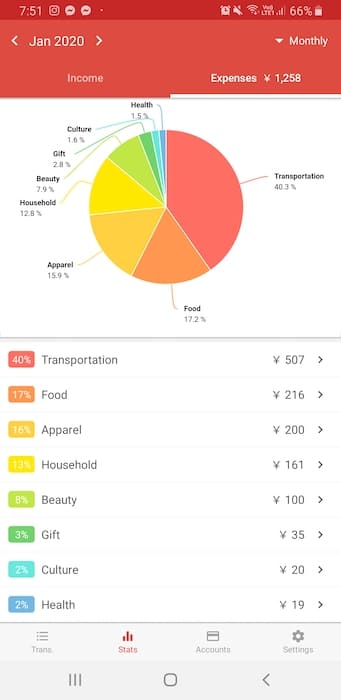 Every month, I’ll look at my expenditure breakdown and think about what I can and cannot save on, whether it meets my spending goals, how I can improve in the following month…
SAVE: Have a travel fund you contribute to regularly.
Whether it’s a physical piggy bank or a virtual account you set up to dedicate savings in it, it will only work when it’s visible so that you know you have to take saving seriously!
$10 a day for 365 days will get you 3 months in Southeast Asia!
EARN: Stop hoarding, start selling!
If you’ve committed to travel, why do you need so much worldly possessions if you are on the road, living out of a suitcase? The best way to earn some extra cash for travel is to get rid of anything you don’t require!
I know it’s subjective. You may be thinking, “I’ll need this at some point in time”, “it’s too pretty to go…”, “there’s sentimental value in it” etc, but ask yourself this: when was the last time you looked at it or even used it? If your answer is more than 6 months ago, it’s time you get rid of them.
Would you pack it in your suitcase for travel, given how heavy/ often you use it? If your answer is no, those items likely can go.
I’ve written a detailed post on where to go to sell used items, and that is where you should go to start selling your used (but needless) items to earn you that extra cash for travel!
EARN: Work part time.
If you are already working, are there any spare time you can fork out to moonlight and work for extra cash?
If you are a freelancer, what are the avenues you can go to obtain extra clients? Maybe you have to put yourself out there and attend networking events to look for potential clients? Maybe it’s time to market your services to friends and family so that they have you in mind when someone might so happen to be looking to hire your services?
If you’re still a student, the lack of experience doesn’t have to stop you! I worked lots in my 4.5 years as a pre-university and university student. There are jobs like tutoring, telemarketing, camp instructing and more that are always open to hiring students. I’ve detailed all the jobs I worked in, including other jobs students can do here.
Even if it doesn’t seem like much, all these extra cash that you can potentially earn in your free time can add up to lots!

EARN: Find a job that allows you to travel.
Be a digital nomad! Before I thrust myself into a life of full-time blogging, obviously I’ve considered various remote working options such as freelance writing and social media management, and I fully set myself up for it.
I gained my experience working in agencies dealing with PR and social media so that I one day can venture out with the skills that I’ve obtained and work remotely.
Of course, there are so many other occupations you can do that will allow you the flexibility to work and travel, or rather, to travel for work. One of which I detail in my next point.
EARN & SAVE: Be a travel blogger.
Duh! The reason why I even got to where I am today! I set myself up to travel for work, so that by incorporating travel into my work, I can travel while earning an income and be on the road infinitely!
Sometimes this “travel blogger” job offers opportunities like sponsored trips and hotel stays as well, which help to allay costs of travelling.
Not only am I able to use this platform to show people that as long as you’re willing to break out of their comfort zones, you can pursue your life’s passions and still earn a living from it, but I also show the beauty of the world and experiences that they’re missing out on!
EARN: Put up your home for an Airbnb listing
Do you own a place? If you foresee yourself being away from home for long periods of time and will have your apartment vacant, why not put it up for visiting travellers to rent so that you can make passive income off it? Here are some tips to boost your Airbnb listing and be on top of everyone else.
Okay! On to finally answering the important question you came here for:
How do I exactly afford to TRAVEL SO MUCH to the point of being on the road FULL TIME?
Here are some nifty tricks to help you stretch your travel dollar, travel longer, and travel cheaper.
Buckle up, you’re in for a really informative post that will equip you with travel tips that changes the way you travel forever!
Pin this for later:
Foolproof travel tips for affordable long-term travel
INSPIRE
1. Brainstorm destinations where you can spend within your means.
You just want to get out there, explore someplace new, try something different, get out of your comfort zone, find an oasis where you can finally relax and do nothing… Yes we all get that feeling sometimes (or all the time in my case).
The first step is to narrow down the destinations you want to go where you can stretch your dollar. Obviously travelling around Asia is much more affordable than in Europe and Americas.
You can get a bowl of piping hot noodle soup in Vietnam for $3 whereas it costs almost $10 or more in other Western countries. I was really stressed getting around London as the £ was twice my home exchange rate so eating out was always twice the amount as what I would usually spend.

In Maldives
So then, pick a place where you can enjoy the comforts of travel yet not have to worry about spending! Instead of counting every dollar that goes into booking a resort in the Maldives, a really gorgeous alternative is to the Philippines, where the beaches and waters are as clear and turquoise as the Maldives! I can vouch for it because I’m a beach aficionado and love both destinations for its beaches.

In Coron, Philippines
My favourite sources of travel inspiration are Pinterest, travel forums like TripAdvisor, Quora, Reddit, Facebook groups and travel blogs (duh!).
Subscribe to your favourite travel blogs’ newsletters and get inspired by the places they’ve been, their budget breakdowns, and keep an eye out for how they can plan out their travel itineraries on your favourite destinations.
Travel groups and forums are really reliable means of obtaining travel tips specific to your queries as they are answered by travellers who’ve been there and done that.
2. Research travel blogs!
Building on the last point, I can’t emphasise this enough. Travel bloggers take the time to research and provide value to their readers with informative destination guides so that readers can gain useful knowledge about these places and prepare their trip better. I know that because I’m in this industry and know how much effort and work that goes behind crafting each post!
3. Travel on off-peak periods
By travelling on off-peak timing, this has helped me make my Maldives dream come true! Hotel prices are slashed by almost half in the Maldives during low season periods.
On the contrary, when I accidentally coincided my Hokkaido trip with Japan’s major Golden Week holiday, not only did I face the problem of high accommodation costs, I also had to worry about shortage of hotel rooms and long queues!
4. Travel to destinations where you have friends in
-

- Friends in Ghent, Belgium
-

- Friends in Nice, France
If you’re looking for ideas on where to go, consider hitting up places where you have friends staying in who might be able to host you. Not only will you be able to stay for free, it’s also a rare chance for you to catch up with friends across the globe!
5. Narrow your destinations per trip
Instead of doing multi-country destinations per travel trip, try narrowing it down to travelling around the major city that you land into.
For instance, instead of using one trip to hit the popular cities of London, Barcelona, Milan, Paris, etc, why not focus your holiday on solely going around the Greek islands, or taking day trips exploring the quaint English villages around London, such as the Cotswolds?
You can get around nearby cities for much less time and money than if you were to fly from one country to another.
Did you know, taking the local bus in England with Megabus is sometimes only a few dollars to get from one city to another with a bus ride? Or that taking Flixbus from Paris to Brussels can only cost €1?
More Europe money saving tricks here!
This way of slow travel can help you to afford to travel more.
6. Plan your itinerary in the city well
How you plan your itinerary when you arrive at your city of interest makes a lot of difference in how you can save money on transport.
Imagine going from point A to B for lunch and then going back to point A for dinner because it was highly recommended. That’s extra transport costs incurred!
Therefore, prior to your trip, read up guide books such as Lonely Planet, Fodors or travel blogs and bookmark the places you want to go.
From there, segment your itinerary based on the number of days you have in the city. Conquer each neighbourhood per day with attractions that are close by so that your itinerary will not involve detouring and repeating the same neighbourhoods on different days and incurring extra transport fees. Time-efficient too!
SAVE MONEY ON FLIGHT
One of my primary motivations of travelling to certain destinations is the impetus of cheap flights! With the competitive costs driven by budget airlines, flying is now cheaper than ever!
I got my flight from Singapore to South Africa for under $1000 return, my flight from Singapore to Japan for $500 and my flight from Singapore to the Maldives for under $300 return via a variety of methods.
1. Subscribe to flight deals
One way to do that is by being kept in the loop of flight deals and error fares. Depending on where you’re from, I found the following sites useful for finding cheap flights to destinations where I’m interested to visit: Secret Flying, Fly4free, Scott’s Cheap Flights.
They sometimes surprise me with incredible fares from Asia to Fiji, New York City and more!
2. Compare prices early
It really helps to be well-prepared if you want to save more on travel costs. It will be highlighted in a few points in this article. One way to prepare for your travel is to compare flight prices early and book at the opportune time!
I use Skyscanner, Momondo, Rome2Rio and Google Flights to monitor prices. This might sound like a lot of steps but it’s easy to put in your destinations and compare which sites offer the best options.
TIP: Be sure you are always comparing the same currency of the destination you’re going! There’s always the option to change currency in your search results either at the top or bottom of the page.
I ALWAYS use Google Flights to monitor prices as they have a price graph that starts tracking flight prices the moment you set the alert. From the graph, you can then tell which are the high and low points of the flight costs and book when it has reached the low price points.
3. Compare alternative route options
Again, being well-researched will help you save on travel costs. I know it’s tedious but it’s a choice and a trade off!
For international travels, it’s often cheaper to travel to a major city then take domestic transport (either by domestic flight, train or bus) to your final destination. e.g. flying from Singapore to Athens by Scoot. From there, you can take a local boat to different islands of Greece, or take a domestic flight to nearby countries.
4. Consider one-way tickets
I’m no flight expert, but based on personal experience, sometimes getting 2 one-way tickets can be cheaper than a return ticket. This is especially true if you’re departing and arriving from 2 different destinations.
For instance, since I didn’t know what my return flight from Japan was (when I was based there), I buy 2 one way tickets instead of getting one overpriced return ticket with flexible return.
The other time, I also bought a one-way ticket to Paris with Malaysia Airlines when I was going to France for my 6 months international exchange, which costed me only USD340!

5. Book budget flights
If you don’t need the extra services that full service flights provide e.g. free WiFi, onboard movies, check in luggage and food, then whenever you can, try and choose the budget flight option.
You can sometimes save over 50% of flight fees by choosing budget airlines over full serviced flights.
6. Pack light
 Building on my previous point of booking budget airlines, one way of saving on check in luggage fees is by packing light!
Learn the art of packing everything into a cabin-sized luggage with these useful travel accessories that are not only light and takes little space, but also organises your items well to maximise the space in your luggage!
Lesser baggage also means lesser things to look out for on top of trying to be safe in a foreign country.
7. Get a reliable luggage/ backpack
On top of packing light, you’ll need a reliable cabin-sized luggage or backpack to stuff everything in and withstand the commute to and from places.
Check out all this list of hardy carry on luggages and this list of best carry on backpacks that you can use forever, for every type of traveller!
Get my 7 AI prompts that saved me $1000s!
SAVE MONEY ON TRANSPORT
1. Consider train passes
-

- In Sri Lanka
-

- Sri Lanka
Depending on how and where you travel, sometimes getting rail passes is the surest way to go.
I wouldn’t say that trains are the cheapest option but they may be slightly more comfortable and more punctual than planes. The ride often rewards you with a view as well. It is also faster than buses, and drops you right in the heart of the city centre. making it very convenient.
If you are the traveller that plans in advance and loves sticking to a schedule, then this is for you. Trains must be booked in advance for a good deal and it is expensive to change or cancel.
In Japan, there are various Rail passes that allows for unlimited train travel and will be more cost-effective than buying separate tickets from one town to another. We got the Southeast Hokkaido pass when visiting Hokkaido to catch sakura during spring.
In Europe, there are Eurail train passes that works the same way. You can learn more about how to use the Eurail train pass in this guide.
Even the USA has train passes for getting around different states if you somehow opt against driving.
Thus, doing proper research for your trip will definitely have you reap returns when you think about all the travel dollars you can save.
2. Or bus passes

Edinburgh, Scotland
There are also passes for bus, depending on where you’re at. If you have your eyes on Europe, don’t miss this incredibly useful and detailed post on all the travel tips to conquer Europe cheaply.
Buses may take longer but this also allows you to avoid the stress of airport security. Some buses also stop in the city centre so that’s an advantage over trains. It may not be as scenic as trains, but if affordability is what you are after, then the bus is for you!
3. Carpool
I’ve used carpooling as a means of getting around France and Spain with Blablacar.
For getting around in Asia, use Grab over traditional taxis for a guaranteed and lower rate. 12Go is also an increasingly popular site for getting around by public transport with competitive prices.
Uber works particularly well in Australia and the USA especially if you are travelling in a group.
Granted, Uber is not cheap at all in Australia and the USA. However, these options can sometimes be cheaper and more time-efficient than going on public transport, if you are going with a group or are arriving at an inaccessible location.
USA also has Uber’s competitor, Lyft, which I love. They give discounts of up to 50% on certain rides! Use invite code ISABEL74763 to get USD5 off your first ride.
4. Public transport
Where possible, try to hop on public transport rather than taking private car hires/ taxis/ going on tours. It will significantly be cheaper.
Check out day passes for public transport – depending on the country, these public transport passes might include discounts on attractions too, like the GO pass in major cities around the world!
5. Hitchhike
This is a backpacker’s best friend. If you’re new to this, it’s getting a free ride by flagging a passing vehicle down with a thumb in the hopes that he will pick you up and drop you off if the driver is heading the same direction as your destination.
I myself haven’t had the guts to travel by hitchhiking. I’ve never dared to do this if I’m travelling on my own.
6. Free walking tours

Walking through the food hall in Alcatraz, San Francisco
Free walking tours are almost rampant in every major city, especially in Europe.
They are led by volunteers who just love showing people around their city. A small tip at the end is customary but not compulsory.
7. Walk!
As much as possible, I try to discover a city/ town by walking on foot. Not only is it a slower pace of travel, by being on the ground, you get to fully stop whenever something catches your fancy and talk to the locals at your own timing.
SAVE MONEY ON ACCOMMODATION
1. Use comparison sites

Town centre of Bruges, Belgium
This is always my first step when looking for budget accommodation.
Sites for cheap accommodation in Europe
HotelsCombined is a more recent site I was invited to try out. It compares all the top accommodation sites (such as Booking.com, Expedia, Hotels.com and Agoda) and present the best offers with just a click of a search button.
They also offer a best-price guarantee, which means they promise to return the difference to you if you find a lower rate somewhere else. It sure makes the search for accommodation less time-consuming now.
Hostels are also great for meeting new people and it is the cheapest way to travel in Europe (and all around the world) if you are travelling alone.
2. Airbnb
Airbnb is an option I always turn to when I’m travelling with more than 2 people. The cost of booking 2 hotel rooms is always higher compared to 1 Airbnb apartment.
3. Opt out of the breakfast option
If your hotel booking doesn’t include breakfast, I almost always opt out of the breakfast option, because they are always more expensive than getting a local breakfast! Head over to a local coffeeshop/ cafe and indulge in the local fare instead!
4. Couchsurf

Couchsurfing in Cologne, Germany
Old school, but that’s something I’ve been doing in 2015 when I travelled around Europe as a student. I stopped for a bit when I was back in Asia, but I still do it in New Zealand and most recently in the US and Japan!
5. Travel forum groups
I’ve recently stumbled upon several Facebook groups that host solo travellers. Similar to the concept of Couchsurfing, it might be worth joining them if you don’t mind staying in the homes of strangers and enjoy the idea of making international friends!
The one I’m in is called “Host A Sister “.

Don’t miss:
6. House sit/ Pet sit
I’ve recently signed up on Trusted Housesitters but because of all the cancelled travel plans and restricted travel, I haven’t personally got to use it yet. It was recommended by a fellow blogger who was raving about her experience pet sitting her way through the US.
This is another way to stay in someone’s house for a low cost! I would recommend doing this if you will be backpacking for an extended period of time because of the membership fee you pay.
In return for free accommodation, you are expected to do some work for your host. For example, to tend to children, their plants or walk their pets.
Do ask specifically what you might have to do and if there are any other hidden costs that you are expected to pay for such as utilities.
This still saves you a ton of money and is a great way to truly experience local living!
Here are the reputable house sitting sites you can consider joining:
- Trusted Housesitters (Membership is USD129/year)
- House Sit Match (Membership is USD35/year)
- Luxury House Sitting (Membership is USD25/year)
- House Carers (Membership is USD 50/year)
7. Camping
 If you don’t mind rugged living, this is a popular choice around the USA, Europe and Oceania. Camp fees (if not free) are still significantly cheaper than staying in a hostel.

SAVE MONEY ON SHOPPING
1. Monitor currency fluctuations
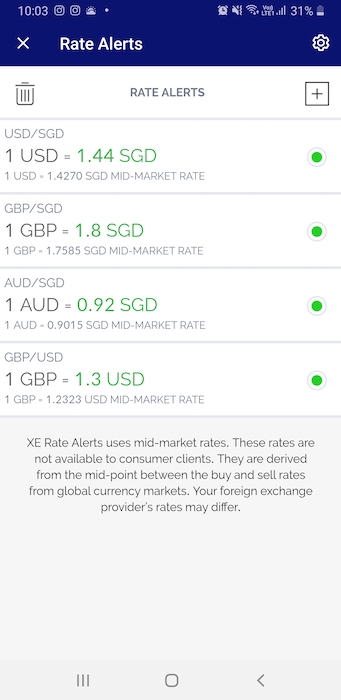
If you’re prudent in monitoring currency fluctuations, you can exchange your local currency with a foreign one when the rate turns for the better. I use XE Currency on my phone app to monitor and alert me when it reaches a certain exchange rate:
 2. Pay in cash instead of credit card
You will have to incur currency conversion costs on top of credit card fees if you pay with a credit card, so unless you have a credit card that you’re using to accumulate miles or points, I would highly advise you to pay in cash!
 Not only that, if you withdraw cash from a local ATM, you also have to bear the ATM withdrawal fees, depending on what card you use.
3. Use an international card
The type that doesn’t charge you transaction or currency fees. Examples are YouTrip (for Singaporeans), Wise (best for digital nomads and freelancers) and Revolut (worldwide), which acts as a multi-currency travel wallet and virtual money changer.
They convert foreign currency from your local currency at the current exchange rate so you don’t incur any extra fee. It is a life changer for me as a frequent traveller!
If you’re still confused over how it works, you can read my review of Revolut here.
Or check out Frugal Flyer to learn how you can use miles and points to elevate your travel game.
4. Use a travel-friendly credit card

If you’re a frequent flyer, having a travel credit card which rewards overseas travel will be to your advantage since you’ll stand a chance at playing the miles/ points game and redeeming free flights or hotel upgrades when you travel.
5. Avoid changing local currency at airports
Don’t ever exchange local currency at airport kiosks unless you absolutely have to. Try to avoid touristy areas too as they will jack up the prices. Go to heartland areas where locals are, or main areas in town. Asking a local for advice on where to go is often the best way.
6. Hit local markets

Farmer’s market in Cape Town, South Africa
I love shopping at night markets in Thailand, fresh markets in Japan and Christmas markets in the USA/ Europe because on one hand, you get fresh foods at reasonable prices, on the other hand, you’ll be supporting local businesses!
7. Haggle like a pro!
While it doesn’t work in every country you go (certainly not too much in Western countries or in Japan), night markets in Asia are made for haggling! Places like Bangkok, Ho Chi Minh and Phuket are so touristy that you are expected to haggle if you want to get anything at a reasonable price.
8. Have a set budget planned beforehand so you don’t overspend
If you’re one of those perfectionist planners, on top of planning your day-to-day activities, perhaps you’d like to write down your projected expenses as well so you have a rough gauge on how much you’d spend, and set a budget in that range.

9. Make a shopping list so you don’t overspend
This is for travellers who love to spend on souvenirs. It helps being organised and listing down who you want to get a souvenir for, so then at least you won’t double-buy items for the people you’d like to gift.
10. Do you really need WiFi/ SIM?
Okay, I’m a huge proponent of going offline when you travel, because this is the only opportunity you get to disconnect and discover the beauty of life. Besides, isn’t that the whole point of a vacation to reset and escape? Don’t get a router/ SIM card unless really necessary.
If you need to navigate on Google maps, I teach you how to do that offline in this post.
SAVE MONEY ON FOOD
1. Avoid restaurants
Enough said. In more expensive places like New Zealand, Europe, Japan or the US, if I’m out exploring for the day, I usually go for supermarket ready-made foods, food stands, healthy fast food or a bakery. I’ll get a sandwich, baguette, wrap or bento and head to a nearby park/ beach to bask in nature.

Takeaway bento by the park in Japan!
2. Eat out at lunch, not dinner
If you have a restaurant you must go, pick lunch over dinner.
3. Cook your own meals

At a cooking class in Bangkok, Thailand
Especially if you are staying in an Airbnb or a hostel and have access to a kitchen, cooking your own meals is the way to go! When I was in New Zealand and cooking, my meals amounted to no more than USD4 per meal.
If you are couchsurfing, maybe make some food to share with your host as a form of thank you.
4. Check out Withlocals
It is a site where you can meet locals that would kindly share a home cooked meal with you for a much cheaper price than a restaurant.
5. Rise early to queue for tickets
If you want to save on online booking fees and time is on your side, the early bird will get its worm!

Alhambra in Granada, Spain
That’s what we did when getting entry into the popular attraction, Alhambra in Granada, Spain. We did it as early as 6am! On another note, we had the whole of Alhambra to ourselves before the crowd streamed in.
OTHER MONEY-SAVING TRAVEL TIPS
1. Travel in a group
 Clearly, if you travel in a group, you’ll be able to split expenses like rental for car, accommodation, etc.
2. Travel alone
I know I sound like I’m contradicting my earlier point, sometimes travelling alone is the way to go. That way, you are not at the mercy of someone else’s stomach, their cravings or their tiredness.
You can walk as long as you want, couchsurf without having to assuage your companion’s fears.
3. Be a frequent traveller
You often get rewarded for being a loyal member of a certain brand. Certain hotels, airlines and credit cards have loyalty perks.
Accumulate miles and fly for free or get free upgrades – there are also a lot of credit cards available today that can already give you bonus points right from the moment that you sign up.
And there you have it! You made it through almost 50 travel tips on how I travel around the world affordably!
Which tips did you resonate most with? Which tips have you not known about before?
Pin this:

